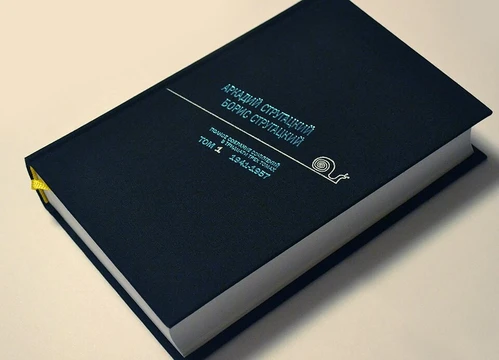
The Doomed City
A 1972 Soviet sci-fi novel about a mysterious sociological experiment.

Wikipedia / Wikimedia Commons
The Doomed City is a 1972 science fiction novel by Soviet writers Arkady and Boris Strugatsky. The title originates from an artwork by Nicholas Roerich that the authors found striking. The novel does not belong to the Strugatskys' Noon Universe and stands apart from their other works.
- authors
- Arkady and Boris Strugatsky
- year_written
- 1972
- genre
- Science fiction
- nationality
- Soviet
- known_for
- The Doomed City, a novel about a sociological experiment in a mysterious world
Lore & Background
The Doomed City is set in a mysterious world where enigmatic Mentors run a sociological experiment. They gathered volunteers from Earth from various times and places, including Germany of the 1940s, the USA of the 1960s, and Sweden of the 1970s. The volunteers can communicate effortlessly despite different native languages. Most live in a City bordered by a swamp and a desert. The experiment appears to run out of control, with social unrest replacing an egalitarian job rotation system with a dictatorship.
The main character, Andrei Voronin, is an astronomer from Leningrad of the 1950s. He initially opposes the dictatorship but later becomes a leading adviser to the dictator. Eventually, he leads an expedition into the desert, facing extreme hardship. Only Voronin and his friend Izia Katzman continue, encountering deserted cities and ruins of Earth cultures. They ponder the meaning of existence and push toward a 'zero point.' Voronin apparently dies shooting at his double, then finds himself back in Leningrad, where his Mentor tells him he passed the first circle, with many ahead.
The authors conceived the idea in March 1969, initially as an autobiography. They worked longer and more diligently on this novel than any other. The draft was finished in 1972 but shelved due to political allusions and ideological vacuum making it unacceptable for the Soviet regime. It was finally published in 1989 after Glasnost and Perestroika eased publishing controls.
Reader's Guide
The Doomed City holds significance as a work that the Strugatsky brothers considered their most labor-intensive, yet it remained unpublished for 17 years due to Soviet censorship. Its themes of social unrest, dictatorship, and existential questioning reflect the authors' struggle with ideological constraints. The novel's delayed publication in 1989, during the liberalization of the Soviet Union, marks it as a product of the Glasnost and Perestroika era. The story's ambiguous ending, with the protagonist returning to his original time and being told of further 'circles,' leaves the experiment's purpose unresolved. The novel stands outside the Strugatskys' popular Noon Universe, offering a darker, more introspective narrative. Its legacy includes being a rare example of Soviet science fiction that directly critiques totalitarianism and explores the nature of human identity and meaning.
Did You Know?
- The title originates from an artwork by Nicholas Roerich that 'astonished' the authors.
- The novel was conceived in March 1969, initially as an autobiography.
- The authors never worked longer or more diligently on any other work than this novel.
- The novel was finally published in 1989 after the easing of publishing controls during Glasnost and Perestroika.
Frequently Asked Questions
What is The Doomed City about?
The novel follows a group of people who find themselves confined to a mysterious, isolated city where they must organize their own society under scarce conditions. It plays out as a sociological thought experiment, examining how a small community forms hierarchies, resolves conflicts, and tests the limits of cooperation when cut off from the outside world.
Is The Doomed City part of the Noon Universe?
No. Although it was written by the same brothers, the 1972 novel shares no characters, settings, or continuity with the Strugatskys' larger Noon Universe cycle. It stands as a self-contained work with its own ambiguous, almost allegorical setting.
Where does the title 'The Doomed City' come from?
Arkady and Boris Strugatsky borrowed the name from a painting by Nicholas Roerich that they found particularly striking. The artwork's title was adopted directly for the novel, lending the story an undercurrent of inescapable fate.
How does The Doomed City differ from other Strugatsky novels?
Instead of space opera or hard-science premises, the book is essentially a closed-room psychological and sociological study set in an undefined, dreamlike location. Its focus is on human group dynamics, conformity, and the fragility of social order rather than on technology or interstellar travel.
Why is The Doomed City considered significant in the Strugatskys' catalogue?
It showcases the brothers' interest in philosophical and ethical questions stripped of their usual science-fiction scaffolding, making it one of their most parable-like works. Fans often point to it as evidence that the Strugatskys could write tight, character-driven social experiments without relying on their broader universe.
More in Novels by Arkady and Boris Strugatsky 1-18
Spotted an error? Know more?
This is a living reference — every entry is fact-audited, and reader corrections feed straight into our audit queue. Suggest an edit · See this site's audit record