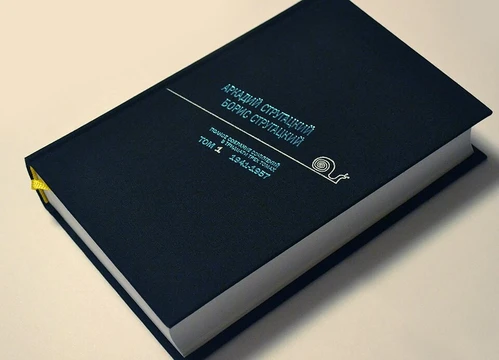
Lame Fate
A novel of two worlds: Soviet writer and rain-soaked exile.
_Lame Fate_ (Russian: _Хромая Судьба_) is a novel by Arkady and Boris Strugatsky, blending realistic fantasy with mystical elements. It was written in 1982 and first published in a magazine in 1986.
The book’s two plotlines both center on the relationship between an artist and an all-powerful state. The “Moscow” chapters follow Felix Sorokin, a middle-aged writer of military-patriotic themes whose biography draws heavily on Arkady Strugatsky’s own life. Sorokin spends his days drinking with fellow writers and working on a tedious commissioned script, but during a week in January 1982, he encounters bizarre events that seem pulled from his old manuscripts: he is forced to obtain an elixir of life for a neighbor, is mistaken for an alien, and meets a fallen angel in a café who offers to sell him the score for the trumpets of the Last Judgment. These fragmented plots never resolve, but they prevent Sorokin from reaching the Institute of Linguistic Research, where he must submit his manuscripts for study. Each evening, he returns to his “Blue Folder”—his most personal, unpublished text.
That folder contains the story of Viktor Banev, a writer living in an unnamed, historically unknown state where he is unwelcome to the authorities. Banev’s world is defined by endless rain and a city whose children have been taken from their parents by masked beings called “wet ones,” said to suffer from a genetic disease and monitored by military intelligence. Banev is in exile there, having been told by the president to “stop strumming.” He reflects on creativity and tries to understand the city’s mystery. When Sorokin finally reaches the Institute, he finds a machine that can measure the value of a writer’s work, operated by a man named Mikhail Afanasievich, who insists the Blue Folder must be completed and reads an ending that does not yet exist. Banev witnesses the old world’s end and the arrival of a bright new one where alcohol and drugs become spring water, fortresses collapse, and weapons rust. He is happy but must “not forget to return,” as this new world is not his.
The idea of objectively measuring a writer’s skill first appeared in the Strugatskys’ work diary in 1971, with further concepts developing from 1977. Work on _Lame Fate_ itself took place in 1982. Initially, Sorokin’s Blue Folder contained the novel _The Doomed City_. In 1985, the co-authors replaced it
- authors
- Arkady and Boris Strugatsky
- written
- 1982
- first_publication
- 1986 (magazine Neva)
- genre
- Realistic fantasy with mystical elements
- original_language
- Russian
- notable_feature
- Dual plot lines: Moscow chapters and Blue Folder manuscript
Lore & Background
The novel's Moscow chapters follow Felix Alexandrovich Sorokin, a 56-year-old member of the Union of Soviet Writers, who writes military-patriotic themes for a living but harbors a secret manuscript—the Blue Folder—about a strange city where it always rains. Sorokin's biography draws on details from Arkady Strugatsky's life. During a January week in 1982, Sorokin encounters bizarre events: obtaining an elixir of life for a neighbor, being mistaken for an extraterrestrial, and buying a score for the trumpets of the Last Judgment from a fallen angel. These interruptions prevent him from reaching the Institute of Linguistic Research, where an electronic machine called Izpital can measure a writer's value.
Reader's Guide
Lame Fate is significant for its layered structure and its reflection of the Strugatskys' long development of ideas about objective measurement of literary mastery, first noted in their work diary in 1971. The Blue Folder initially contained the novel The Doomed City, but in 1985 the co-authors replaced it with the standalone novella Ugly Swans (written in the 1960s but unpublished in the USSR). The first publication in Neva (1986) had censorship excisions due to the Gorbachev anti-alcohol campaign. The full edition, alternating Ugly Swans with Sorokin chapters, appeared in 1989 and has been repeatedly reissued. The novel's legacy includes separate publications of Lame Fate and Ugly Swans in the 'Worlds of the Strugatsky Brothers' series, and both variants (with inserts from The Doomed City and the final text) in the complete 33-volume collected works.
Did You Know?
- The novel's Blue Folder originally contained the text of The Doomed City, later replaced by Ugly Swans.
- The first magazine publication in Neva (1986) had censorship excisions due to the Gorbachev anti-alcohol campaign.
- The character Mikhail Afanasievich reads Sorokin a finale that has not yet been written.
- The plot device of an electronic machine measuring a writer's value was inspired by Ryūnosuke Akutagawa's story Mensura Zoilii.
Frequently Asked Questions
What is 'Lame Fate' about?
The novel interweaves two stories: one follows a drunk, middle-aged Soviet writer named Felix Sorokin who has a strange mystical encounter in Moscow, while the other is a manuscript called the 'Blue Folder' depicting an artist struggling against a totalitarian regime in a rain-drenched world. Both plotlines explore the tension between creative freedom and an omnipotent state.
What is the 'Blue Folder' in the novel?
The Blue Folder is a fictional manuscript discovered within the story, containing a tale about an artist who creates a painting of supernatural power in a dystopian, rain-soaked society ruled by an all-powerful government. It serves as the novel's more fantastical layer and mirrors the Moscow storyline's themes of artistic oppression.
Who is Felix Sorokin and is he based on a real person?
Sorokin is a middle-aged writer of military-patriotic scripts who spends his days drinking with colleagues and grinding through a tedious commissioned project. His character is widely understood to be heavily inspired by Arkady Strugatsky's own life as a Soviet writer navigating the system.
What does the title 'Lame Fate' signify?
The title suggests that fate or destiny is not an all-powerful, perfect force but rather something flawed and limping—imperfect and incomplete. This idea runs through both plotlines, where the characters' encounters with mystical or fateful forces reveal them as unreliable rather than absolute.
Why was 'Lame Fate' written in 1982 but not published until 1986?
The novel was completed in 1982 but faced the typical Soviet publishing delays and censorship hurdles of the era. It finally appeared in the literary magazine Neva in 1986, during the period of perestroika when previously suppressed works began reaching readers.
More in Novels by Arkady and Boris Strugatsky 1-18
Spotted an error? Know more?
This is a living reference — every entry is fact-audited, and reader corrections feed straight into our audit queue. Suggest an edit · See this site's audit record